
In working with the St. Louis City’s Planning and Urban Design agency, we created a theoretical model of an Urban EcoBlock to help them conceptualize this. We recently updated the model to estimate energy loads for each new and existing building based on gross square footage and EUI, and determined the capacity of each rooftop for solar, along with the common areas. Here’s what it looks like to be net zero energy:
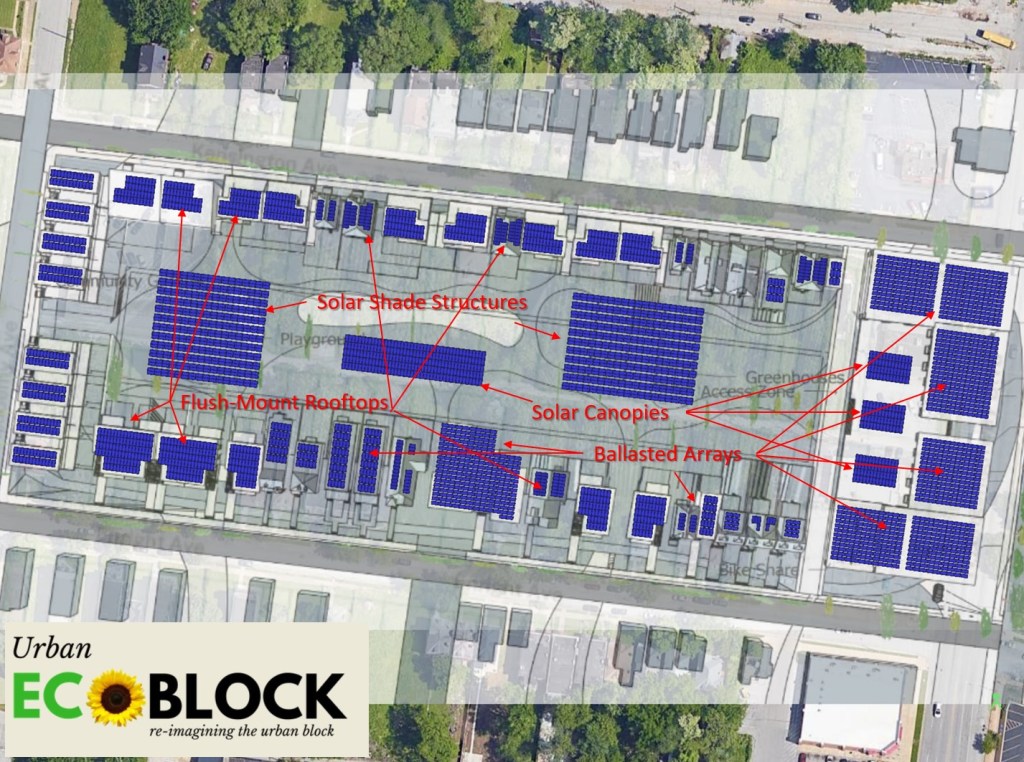
The model that was created is not actually a real project, but rather a sample block in the Academy-Sherman Park neighborhood in St. Louis. This model assumes the renovation of 16 existing homes totaling a about 42K ft2on the block to make them more energy efficient. Proposed new construction includes 16 single family homes and five multifamily homes totaling 67K ft2, eight apartment buildings with three units each totaling 24K ft2, and four large mixed-use buildings totaling 115K ft2 with a central parking garage for shared EVs. Most of the new homes have been designed with single-plane south-facing roofs to enable us to maximize the amount of solar on the roofs. Flat roofs on apartments and commercial space have traditional ballasted arrays, with the solar panels oriented in a way to optimize capacity. The common ground includes solar shade structures and canopies that can be sized appropriately to supplement rooftop capacity. Many of the existing buildings have east-west roofs that aren’t ideal for solar, but can help contribute to the overall production.
This model is expected to include a storage to provide consistent power and enable resiliency during power outages. Our expectation is that the block would be interconnected to the grid through a single master meter, with the community sharing clean energy from leased solar equipment and with costs proportionally allocated based on individually-metered usage. The total of 1.6 MW of solar is projected to produce 2,154 MWh of energy annually.
Consumption is based on aggressive EUIs, including 25 kWh/ft2 for residential, 30 for the mixed use buildings and 40 for renovated existing homes. We are also working with a Dynamic Engineered Systems to estimate the tonnage requirements for block-scale ground source heating & cooling system based on these loads. The design is expected to incorporate valves to increase capacity over time as construction is completed, and isolate loops as needed for repair.
It’s possible to do this. Help us make it happen!
 Urban EcoBlock